Psychology Class Notes > Biological Psychology (Psychobiology)
1) Life as a single celled organism
a) minimal abilities -- the single cell organism can find food and ingest it, can move away from irritating environmental factors, maybe even learn and habituate to stimuli.
b) However, there are some problems -- as a single celled organism, when improvement or focus is given to any one ability, there is an associated decrement in others. With many functions, too much emphasis on one function causes others to suffer.
2) The colony
a) a solution -- one day you (a single cell organism) are crawling around and run into another (an amoeba). You make a deal. You like to crawl around, it likes to ingest. So, the two of you team up, form cells or societies and make use of each other's skills. You compensate for its shortcomings and it compensates for yours. Together, you are far more efficient, productive, and thus, more likely to survive and reproduce.
b) specialization -- soon, specialization begins occurring (some movement, some sensitivity to environmental stimuli, others to irritation from environment, other secretion) - this means a reduction in flexibility of individual cells. Each cell becomes dependent on other cells for certain functions - while there is an increase in the ability to deal with the environment when together, there is a decrease in the ability to deal with the environment when cut off from the other cells.
All of this leads to advancements in cell organization and development. Now, multi-celled organisms begin to evolve and adapt to their environments. Now we can take a closer look at the individual cells (neurons) and their components. Let's examine the Neuron and its components.
I. The Neuron
Take a look at an image of the neuron

A. Types of NeuronsThe majority of neurons are located in the brain - approx. 100 billion in the brain, although this is debatable.
Each neuron receives information, on average, from tens of thousands of other neurons, making it the most complex communications system in creation.
1. Sensory Neuronsalthough most communicate within the central nervous system (CNS - brain & spinal cord), some do get signals from outside the central nervous system. There are three major types of neurons upon which information travels. In addition, the information travels from the Sensory Neurons to the Interneurons, and then finally to the Motor Neurons.
2. Interneuronsbring information from sensory receptors to the central nervous system. Brings information from the eyes, ears, etc., as well as from within the body like the stomach.
3. Motor Neuronsneurons in the brain and spinal cord that serve as an intermediary between sensory and motor neurons. They carry info around the brain for processing.
carry the information from the CNS to the appropriate muscles to carry out behaviors.
For example, if you hold your hand over a hot flame, the information about "heat" travels from your hand on the sensory neurons, to the internuerons where it is brought to the appropriate brain region to process the information (now you know it is "hot") and make a decision about a corresponding action (too hot, let's move the hand). The information then travels on the Motor Neurons from the brain to the hand so that your muscles move the hand from the hot flame. See how easy that is?
B. Structure of the Neuron (image of the neuron)
1. Soma - the cell body which contains the nucleus, cytoplasm, etc. Everything needed for survival.
a. dendrites - specialized branch-like structures used to receive information from other neurons. The more dendrites a cell has the more neurons it can communicate with.
2. Axon - thin, tail-like fiber that extends from the soma to the terminal buttons. This can range from as small as a red blood cell to 3 ft long.
a. axon hillock - area where the axon connects to the soma.
b. myelin - a fatty substance that covers the axon that serves 2 purposes:
the myelin forms a a sheath (covering) called the myelin sheath that helps the signal travel faster along the neuron (see Nodes of Ranvier below), and it also protects the axon from damage and signals from other neurons.
The myelin sheath is not indestructible, but can deteriorate - For example, multiple sclerosis - signals are impeded and don't get to and from the brain properly.
c. Nodes of Ranvier - myelin sheath is not an even cover, but there are areas that are covered and others that aren't. The areas w/o myelin are the nodes of Ranvier. The way this helps speed up transmission is that the electrical current/signal jumps from Node of Ranvier to Node of Ranvier instead of traveling down the entire axon.
d. axon terminal - area at the end of the neuron where it meets another neuron.
BUT ONE NEURON ALONE IS MEANINGLESS - THEY MUST TALK! They communicate using an electrical signal called the Neural Impulse (sometimes it is combined with chemical signals...you'll see).
II. The Neural Impulse
Defined as: the electrical and chemical transmission of information from one neuron to another. (Take a look at two neurons)
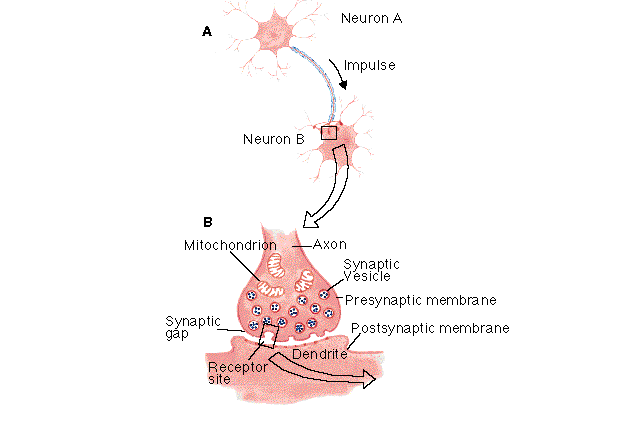
A. Neural impulse - takes the same path all the time - it is a process of conducting information from a stimulus by the dendrite of one neuron and carrying it through the axon and on to the next neuron. Let's take a look at what's involved in the neural impulse:
1) ions - we have positively (+) and negatively (-) charged particles called ions. For the neural impulse, however, we are only concerned with Sodium (Na+) and Potassium (K+).
2) selectively permeable membrane - the outer membrane of the neuron is not impermeable, but instead selectively allows some ions to pass back and forth. The way it selects is easy - it has pores that are only so big. So, only very small ions can fit through. Any large ions simply can't pass through the small pores.
3) charge of the neuron - inside the neuron, the ions are mostly negatively charged. Outside the neuron, the ions are mostly positively charged. In this state (with mostly negative charge inside and positive charge on the outside) the neuron is said to be Polarized.
4) resting potential - while the neuron is Polarized, it is in a stable, negatively charged, inactive state The charge is approx. -70 millivolts, and it means that the neuron is ready to fire (receive and send information).
5) stimulus - eventually, some stimulation occurs (ex. hand to close to a flame), and the information is brought into the body by a sensory receptor and brought to the dendrites of a neuron.
6) action potential - once the stimulation (the heat) reaches a certain threshold (come to later) the neural membrane opens at one area and allows the positively charged ions to rush in and the negative ions to rush out. The charge inside the neuron then rises to approx. +40 mv. This only occurs for a brief moment, but it is enough to create a domino effect.
7) repolarization - the neuron tries to quickly restore it's charge by pumping out the positively charged ions and bringing back the negative ones. Can occur fast enough to allow up to 1,000 action potentials per second.
8) absolute refractory period - after the action potential occurs, there is a brief period during which the neuron is unable to have another action potential. Then the charge inside the neuron drops to about -90 mv (refractory period) before restoring itself to normal.
9) speed of an action potential - can travel from 10120 meters/sec, or 2-270 miles/hour.
10) all-or-none law - a neural impulse will either occur or not. There is no in between. Once the threshold is reached, there is no going back, the neural impulse will begin and will go through the complete cycle.
Threshold - a dividing line that determines if a stimulus is strong enough to warrant action. If the threshold is reached, an action potential will occur.
III. The Synapse (this is a list of the components that make up the synapse)
A) definition
area where the axon terminal of one neuron meets the dendrite of another neuron. They do not connect, but there is a small gap called the SYNAPTIC CLEFT/GAP.
B) pre & post synaptic neurons (a small cleft can be jumped by the impulse)
as you can guess, these are the neurons that, 1) have the information to pass on to the next neuron, and 2) the next neuron waiting to receive the information.
C) neurotransmitters - chemicals that carry information from one neuron to the next.
when the synaptic cleft is too large to be jumped by the neural impulse, the signal/information must be passed using chemicals as (neurotransmitters) instead of electrical currents.
D) transmission of neurotransmitters
When the synaptic cleft is too large to be jumped, the gap can be crossed using neurotransmitters located in sacs within the axon terminal (the end of the axon). The sac with the appropriate neurotransmitters is forced through the membrane into the cleft, releasing the neurotransmitters into the cleft. Neurotransmitters then make their way to receptor sites on the post-synaptic neuron, where they stimulate the neuron and the action potential begins again.
Receptors - the receptors on the post-synaptic neuron are specific, and thus will only allow certain neurotransmitters into them. In essence, it is very much like a lock and key - you must have the right key (neurotransmitter) for the right lock (receptor site)
E) recycling - after neurotransmitters have been used, they are recycled by the body for later use. They are broken down by enzymes so that they vacate the receptor sites, and then brought back to the axon terminal and stored. Pretty efficient, wouldn't you say?
F) types of neurotransmitters (approx. 60, but let's just only touch on two of them)
1) acetylcholine (ACh)- found in parts of the peripheral nervous system (PNS), spinal cord, & areas of the brain.
in PNS - ACh activates muscles that help the body move. But also is inhibitory since it helps the body slow down in the parasympathetic nervous system
in Brain - ACh is involved in breathing, attention, arousal, motivation, etc.
problems occur if ACH functioning is hindered
For Example - South American Indians use curare on the tips of arrows for hunting. The curare binds to the receptor cites where Ach binds, so the Ach can't work, this results in paralysis and death.
Another Example - the black widow spider uses venom that causes flood of ACh into neuromuscular synapses which results in violent, uncontrollable muscle contractions, paralysis, and death.
2) Dopamine - involved in movement, learning, reinforcement, etc. Has been associated with several clinical disorders such as schizophrenia.
Dopamine Hypothesis (of schizophrenia) - one possible explanation for Schizophrenia is that there is an excess of dopamine at certain synapses in the brain. The increased dopamine levels produces abnormal, problematic behaviors. There are 3 ways this can occur:
a. presynaptic neuron produces too much dopamine.
b. dopamine is not removed from cleft, so keeps working.
c. oversensitive postsynaptic neuron receptors (Most popular)
IV. The Two Nervous Systems
A. Central Nervous System (CNS) - consists of the brain and spinal cord
1) Spinal Cord
bundles of neurons that extend from the base of the skull to just below the waist, and act as an information link between the brain and the rest of the body.
2) Brain
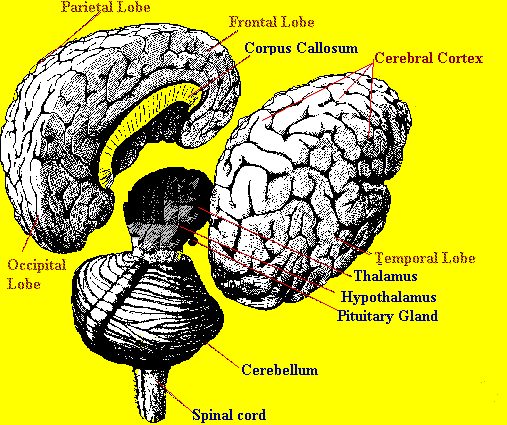
the brain has 3 major divisions - hindbrain, midbrain, & forebrain (image of the brain)
a. hindbrain - attached to the spinal cord and is responsible for many automatic functions such as breathing and heartbeat, as well as some voluntary actions like walking and facial movements.
b. midbrain - area of the brain that serves primarily as a relay station between the forebrain and hindbrain, but does control some bodily movements like the startle reflex.
c. forebrain - the largest and most complex region of the brain.
1. cerebrum - center for complex thought. Involved in learning, remembering, thinking, and consciousness. Divided into two halves (hemispheres) that are connected by the corpus callosum - if split, hemispheres can't communicate, but that does not mean that a person can't survive. There is a large and interesting body of research on split brain functions. Please check your text book for this.

B. Peripheral Nervous System (PNS) - carries information from the sense organs to the CNS and then from the CNS to the muscles and glands.
1) Somatic Nervous System - nerves that connect the voluntary skeletal muscles and to sensory receptors (skin, muscles, & joints).
2) Autonomic Nervous System - nerves that connect the heart, blood vessels, smooth muscles, & glands. Controls automatic functioning like heart rate, eye blinking, & digestion. Controls much of the physiological arousal you experience from emotions. It is this nervous system that is involved in the famous fight-or-flight response.
a) fight-or-flight response - Walter Cannon (1932) - found that when confronted with dogs, cats responded by : 1. preparing to fight; 2 preparing to flee. People are the same.
1. sympathetic nervous system - prepares the body for emergencies. Responsible for the fight-or-flight response: brings blood from internals to externals (muscles), slows down digestion, signals adrenal glands to release hormones, etc.
2. parasympathetic nervous system - slows body down, conserves bodily resources: slows heart rate, reduces blood pressure, etc.
V. Genetics (this is going to be covered very, very, briefly)
the study of heredity (characteristics transmitted by the genes a person is born with).
1) Gene - DNA segments that serve as the key functional units in hereditary transmission.
a) genotype - all of the genes you are born with (the combination of these genes and environmental influences form a person's observable characteristics).
b) phenotype - the expression of your genetic makeup (eye color, height, hair color, etc).
2) Chromosomes - thread-like strands of DNA molecules that form the DNA segments.
every cell in the human body has 46 chromosomes; 23 from mom, 23 from dad.
each parent's chromosomes can be scrambled 8 million ways to give approx. 70 trillion possible configurations.
the more closely related we are the more genes we have in common, the more similar we are to one another.
a. autosomes - all chromosomes except sex chromosomes, which regulate such things as eye color, hair, body size, etc.
1. dominant genes - genes that are expressed when paired genes are mixed
2. recessive genes - genes that are masked when paired genes are mixed.
3. homozygous genes - the combination of two similar genes in a pair (bb, BB, etc)
4. heterozygous genes - the combination of two dissimilar genes in a pair (Bb, etc)
b. sex chromosomes - one pair of the 23 chromosomes from each parent which determines your gender.